
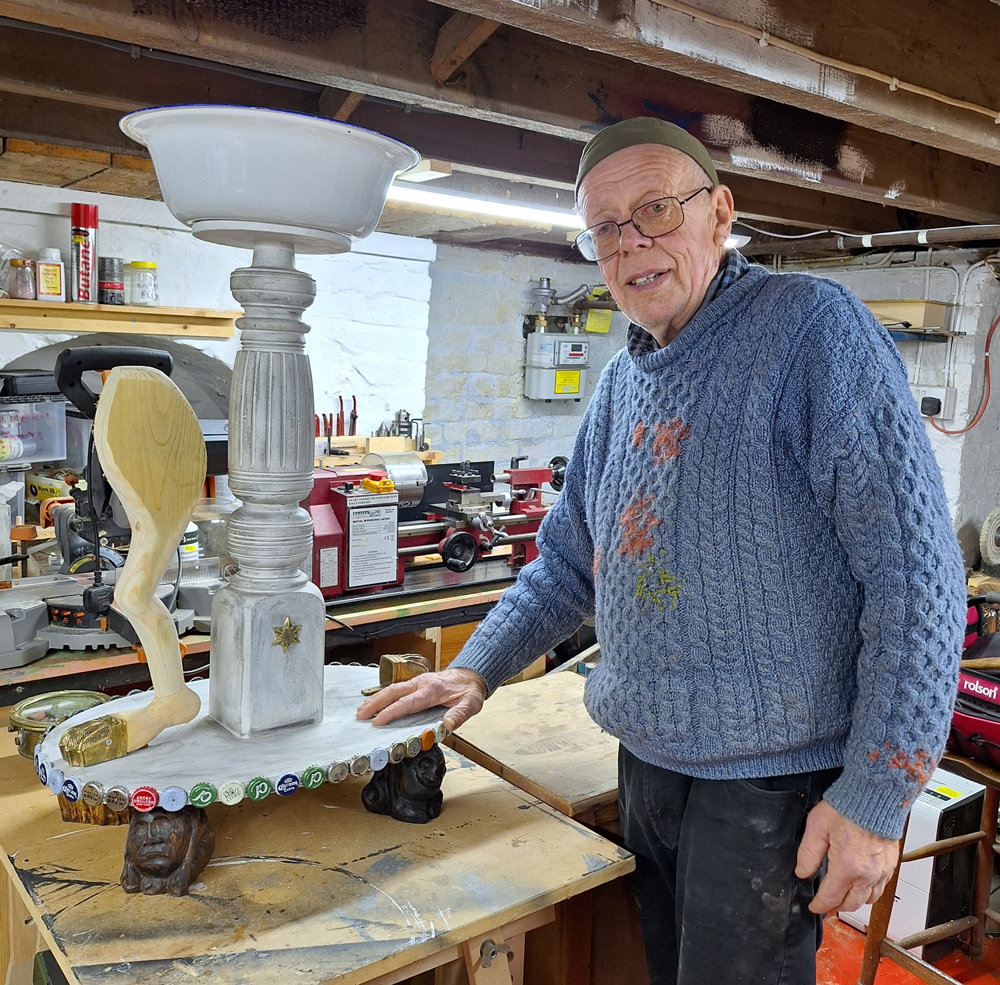
Bob Lamoon at work in the studio with Cliftonville Laver (work in progress) which will be shown in The Void, a site specific installation at Chancel Gallery Murston in 2024
Read Time: 7 minutes
Robert Lamoon talks about his journey as a multimedia storyteller and gives a glimpse into one Tiny Book contributor’s creative process.
Hope Fitzgerald: Hi Bob, on your website you call yourself a Multimedia Storyteller. Tell me about that.
Robert Lamoon: It came from when I shared a residency at The Beaney House of Art and Knowledge in Canterbury, with Jill Holder. People want to put you into a little box as an artist. I work in all media and so I started to call myself a multimedia storyteller. For most of my work, the story is the most important thing. Titles are important. I don’t like necessarily having a blurb next to a painting, but sometimes a painting’s stories might come from things that I’ve seen – myths, legends, stories I’ve heard in India.
HF: The story comes first and the media is a response. Can you talk about that a bit more?
RL: I do a lot of thinking before I actually start making. The creative part and the medium is determined by the story. It can be a collection, or it can be painting. I’m doing more site specific installations rather than one-off pieces now. I started thinking of changing from storyteller into object maker. We’re surrounded by objects, aren’t we? Everything is objects. Maybe that’s where my work is moving towards. I spend a long time in places like the British Museum looking at objects. That’s making my work go in different directions. The work might be 3D or it might be 2D, but suspended which possibly makes it 3 dimensional. I don’t know. I don’t worry about it too much. It’s a working title.
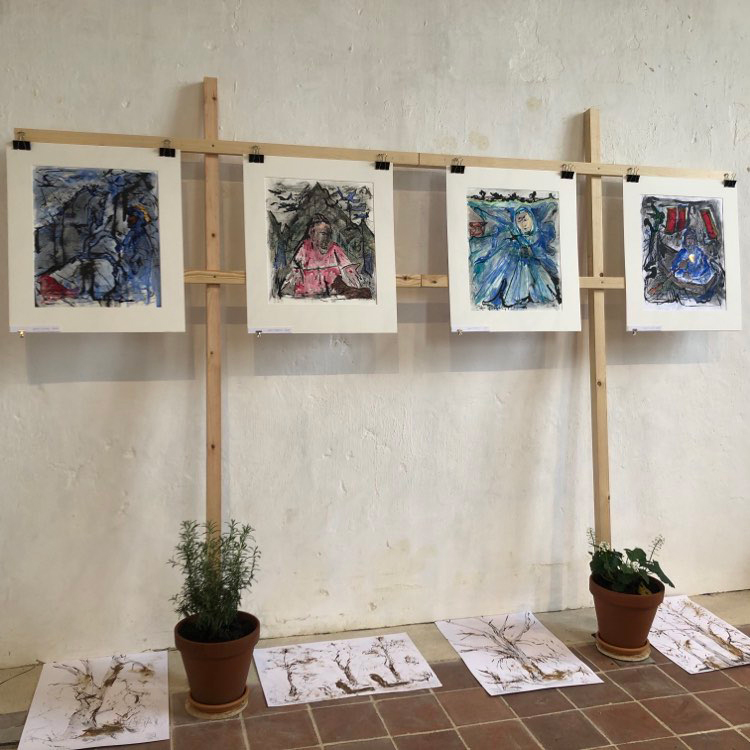
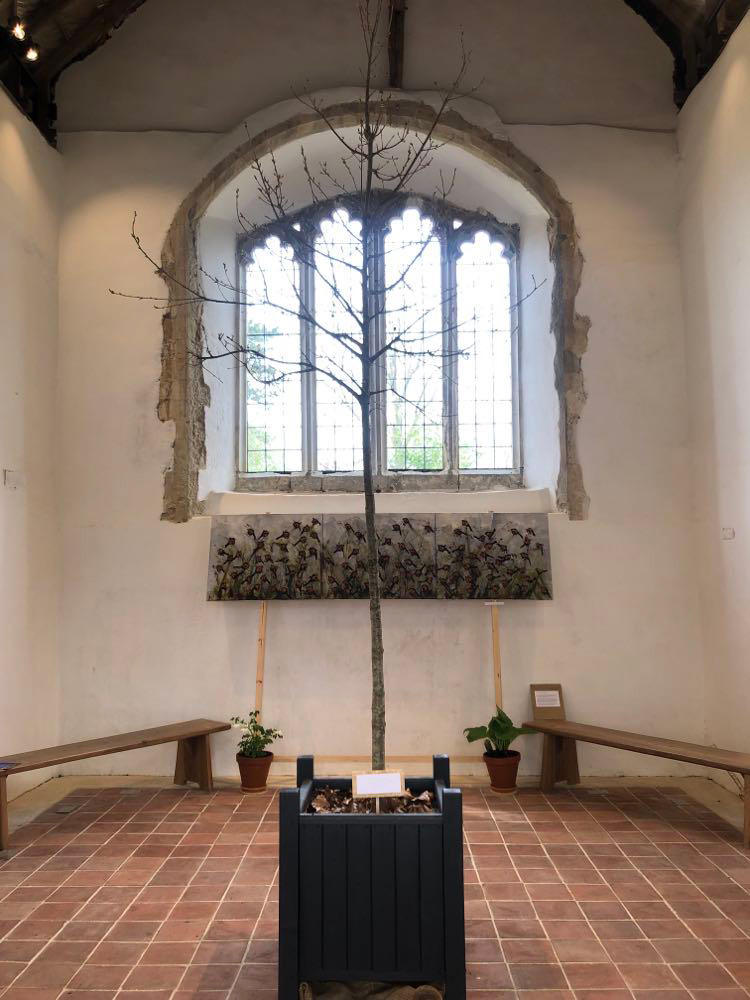
HF: Do you have a daily practice that you want to share? I’m interested in the idea of having thinking space, and the invisible work that gets done that is part of the process.
RL: I do have a daily practice. I draw every day just to keep my hand in. My next exhibition is going to be more about landscape and trees, so I get to spend a long time out at Belmont (House) looking at the trees and drawing those. Part of my practice, I suppose, is meditation as well. I meditate every morning for 40 minutes. That sets me up for the day. I’m not particularly fussed about how much I do during the day, as long as by the end of the day I have done something, that’s important for me. Whether it’s going to be out there to be seen or just in my sketchbook. Sometimes I sit looking at my work for a long time. In all my studios, I have a chair where I can sit and look. I might fall asleep, think about it, and then I wake up and the problem has been solved, which is good.


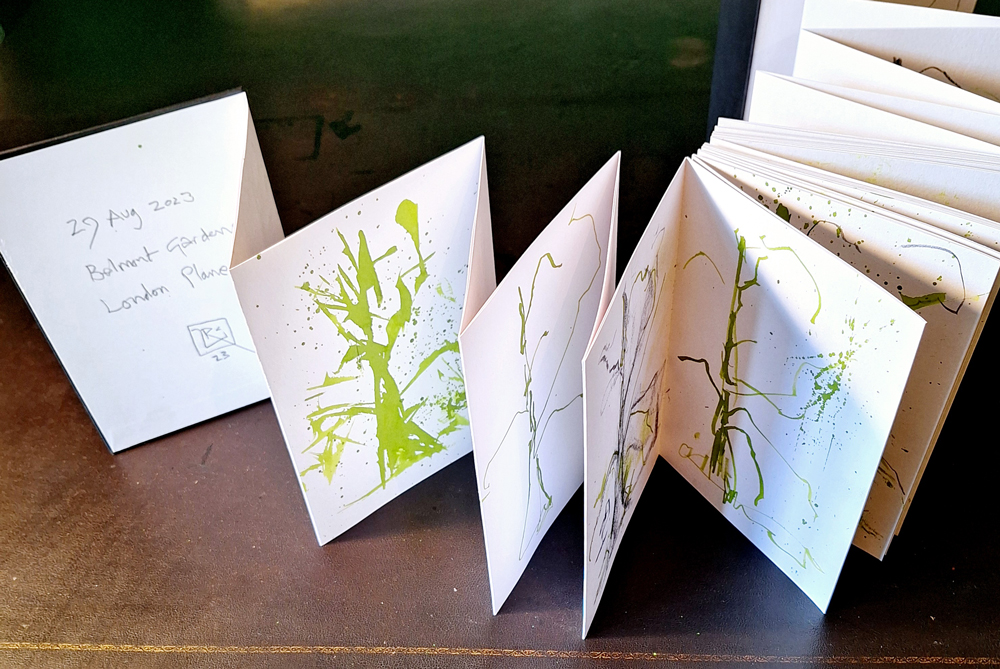
Concertina Notebooks: Bob says, “I love concertina sketchbooks. I’ve used them to draw trees. This was over a couple of years. I went to Kingswood and drew a tree on the Summer solstice 36 times. The story there was how I was thinking about the tree, how I was learning about that one tree. I went back for the winter Solstice and I drew the tree again in another book. In the third concertina book, I went to Belmont to draw one particular London Plane tree that I love. I stretched the book out across the grass and drew with a feather and stick and ink.”
HF: Tell me about your Tiny Book. You did it in a day and it’s the quickest I’ve ever had it back!
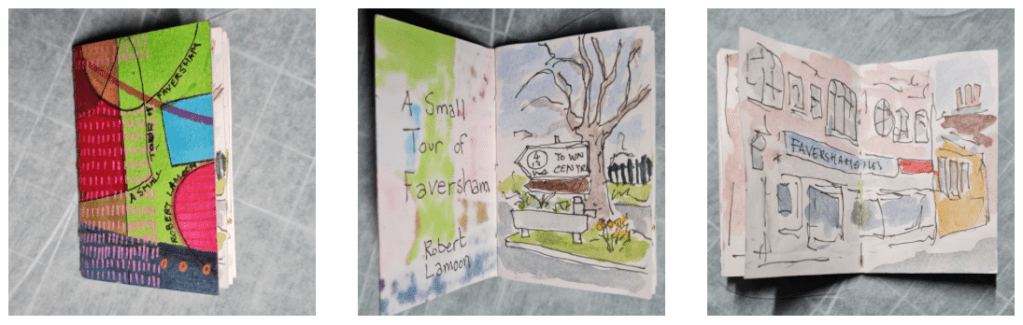
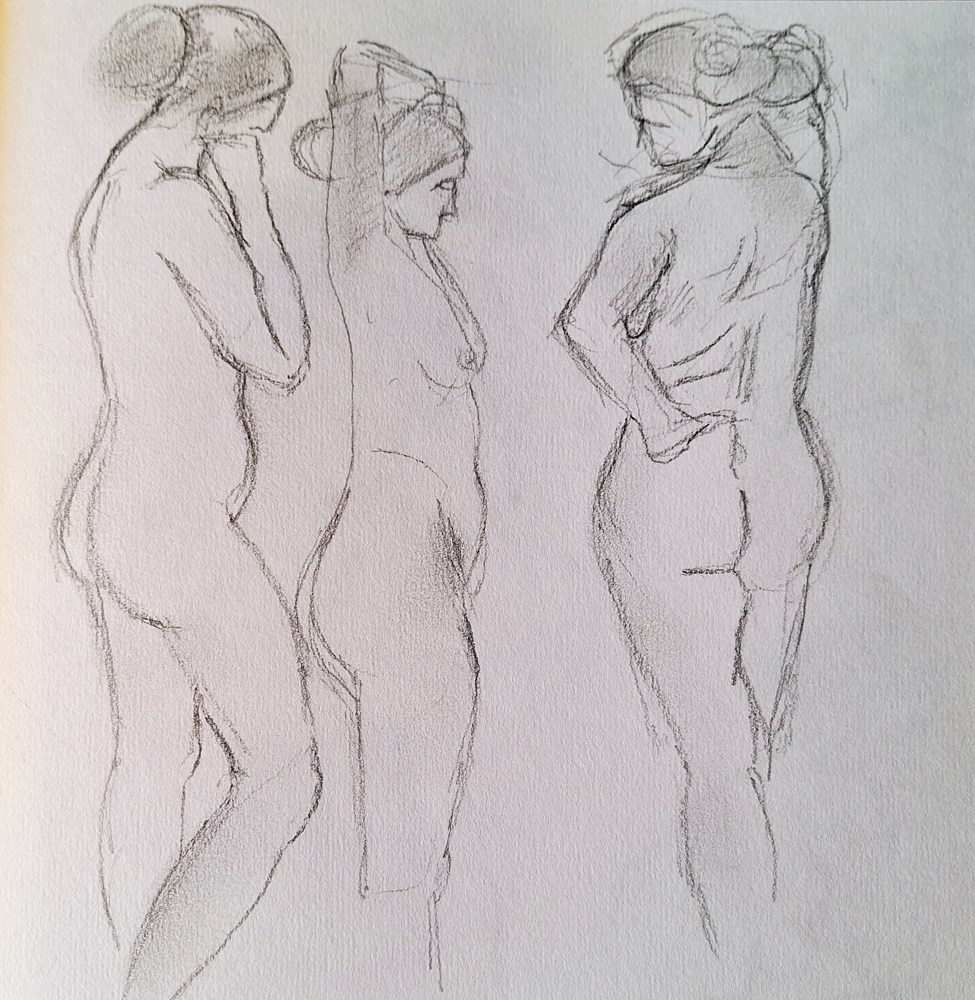
RL: I wanted to be quick because it was a journey. The story was the journey, walking around the town. Because of the Tiny Book’s size, it was quick little drawings and job done. I enjoyed that very much. I draw very quickly because I don’t like it getting too tight. My drawing used to be very tight and was more graphics based rather than this much freer, open spontaneous line. When I was teaching computer graphics, my work was very hard edge. 15 or 20 years ago, I thought I’ve got to unlearn everything that I’ve been doing. I think it’s important to see the artist in work. People like Frankenthaler – you can see the painterly marks. I find that just so beautiful. Exciting. And that’s what I was trying to get into my work a lot more now. I still do very accurate drawings sometimes, particularly with life drawing. I think it’s important that I still maintain that ability to be able to draw well and accurately. Take Picasso. Behind his skill, his beautiful work, there’s a hand of someone who can draw very well. I want to be able to draw perfect circles. Then it becomes muscle memory, how to do that thing, so when I’m drawing it’s like driving a car, my body will just do it. I like life drawing because I think it’s the pinnacle of drawing – change it just slightly and it’s a completely different person. When I’m life drawing it’s such an intense observation and then trying to get that line exactly how I wanted it on the paper…it can be draining.


HF: Tell me about something you’re working on now.
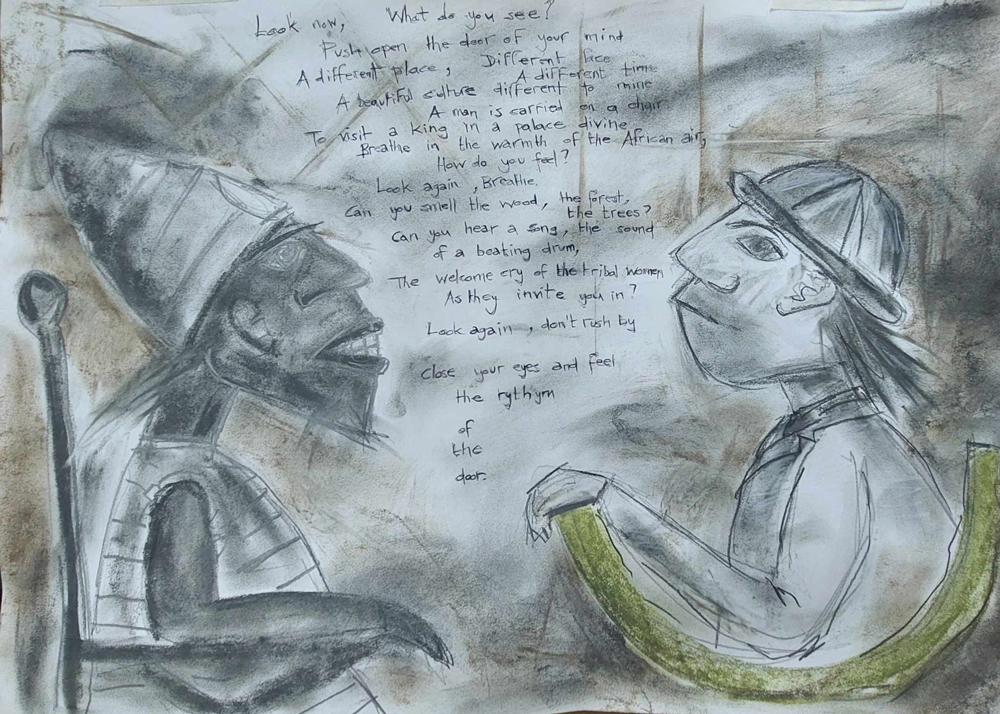
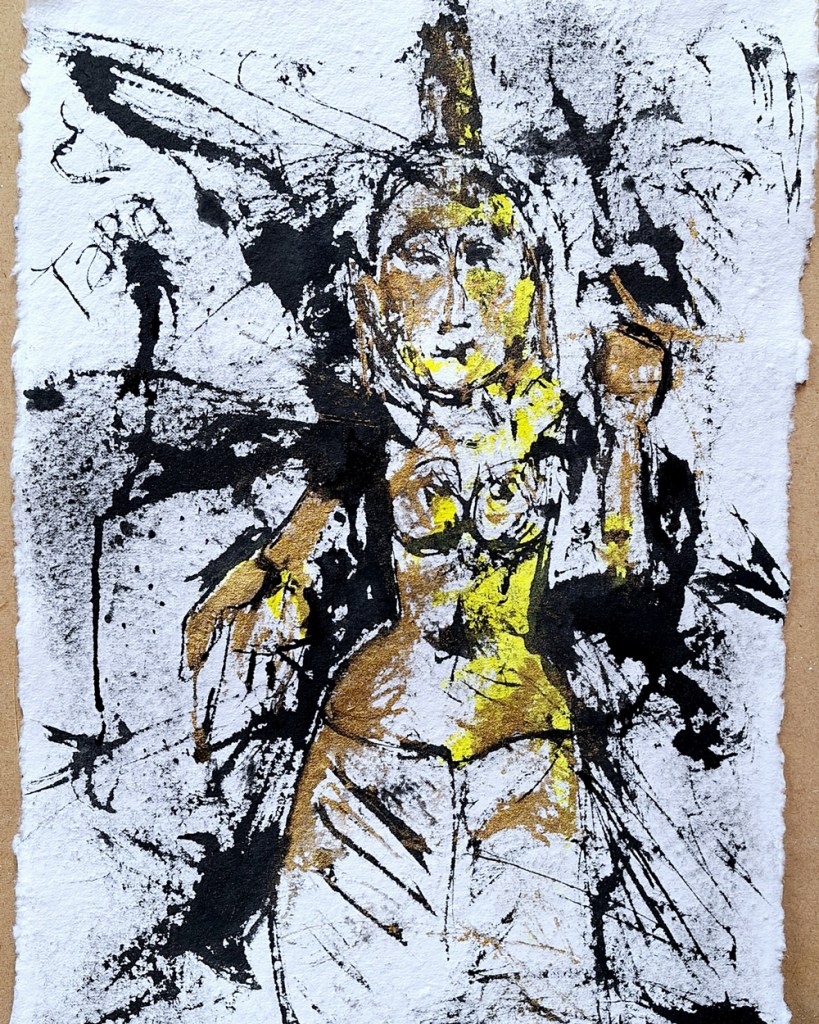
RL: I’ve started a new collaboration with James Ransom looking at 36 objects in the British Museum. I like the idea of collaboration. My practice has changed considerably through working with other people. We look very closely, together or at different times. I do a drawing inspired by the object and he writes about it. It’s going to be quite a long collaboration resulting in a book called the Poetics of Objects. Books have always been an important part of my practice. It will be a one of a kind work – quite large because some of the drawings are big. I don’t know how it will be displayed or presented yet, so that’s going to be an interesting one. I like to be slightly out of control, brought on by knowing someone else is having input into the work.
HF: Are you doing any teaching, Bob?
RL: Yes. Mindfulness drawing at Belmont (House and Gardens). The first one is coming up in April. It could be for anyone, but I like it where there’s people who say they can’t draw. These courses are not about trying to make finished works. It’s experimenting. I don’t like the word playing. For me, art can never be play. It’s hard work. I can’t think it’s a really joyful experience until it really starts to work. This part is amazing because sometimes I think where the hell did that come from? I’m passionate about doing it, but it’s not playing. It’s experimenting, which is a different thing I believe. The difference between looking and seeing is what I want to get across in my drawing courses. Seeing means understanding. We all look all the time but it’s seeing when we really think about it. Seeing is in the mind.
HF: Experimenting and figuring stuff out can be uncomfortable because you’re in a not-knowing space, I think.
RL: Yes, and I’ve always thought that drawing is just a learned skill. You’re not born with it. I don’t think I’ve ever been out of my comfort zone with drawing – I just do it. Not very well sometimes. Sometimes it’s great, sometimes it’s a load of rubbish. That doesn’t matter. When I started doing these drawing classes, I wanted to know how it felt to be slightly panicky about being out of your comfort zone so I decided to learn to sing. I’ve not sung since the age of 11. I was in the school choir, and then I stopped singing. I’ve never even sung Happy Birthday to anyone. I got lessons from a local woman and it was really stressful. She said, “OK, start singing” and I said, “No, can’t we just talk about this?” (laughs) But anyhow, after, I don’t know, six months or so I stopped lessons. My teacher said “You’re right – you know you’re doing OK, and it’s just practice. Just keep up the practice.” I knew what I was doing sometimes was absolute rubbish. I wanted to stop and give up. And that’s how people might feel about drawing, or any skill. This year I’ve set myself a new challenge to learn to play the saxophone. I’ve just had a recorder come in the post. A friend of ours is a world class saxophone player and he said to start by playing the recorder. So I’m going to give that a go soon.
HF: Are there days that you don’t feel like making?
RL: Yes, and I just let it go. I feel like I hibernate at this time of year cause it gets dark early. You know, I should go and sit by the fire and read a book. That’s what I love about the summer. On long days, I’ve never been at a loss for something to do with so-called artist’s block. Yeah, there’s days when I don’t draw. I’ve drawn today. Maybe not for long. I don’t have to feel creative, but I’m always doing something. I just got some new polish for wood, so I’m polishing all the furniture and all the bannisters in the house, because I love it and I think our house is a creation as well. I love hanging and curating the shows at Creek Creative because people give me the freedom to put their work up in my own way.At the Gallery, what I really love is that on the Monday morning, all the work is there. I might see the artist and ask if there is anything they particularly want. If not, they go away, and then I look at all the work and I put it all together in a way that starts to sing. I’ve got that day to do it, so I don’t have the luxury of thinking about it for a week. That’s nice because I’m actually creating with someone else’s work. I’m creating another thing. I’m creating an installation.
Where to find Robert Lamoon:
Instagram: @robertlamoonart
Website: www.robertlamoon.com
Solo shows in 2024 at Chancel Gallery Murston
Into the Trees Spring 2024
The Void – site specific installation Summer 2024
Text: Interview and Edit by Hope Fitzgerald Images: Robert Lamoon & Hope Fitzgerald